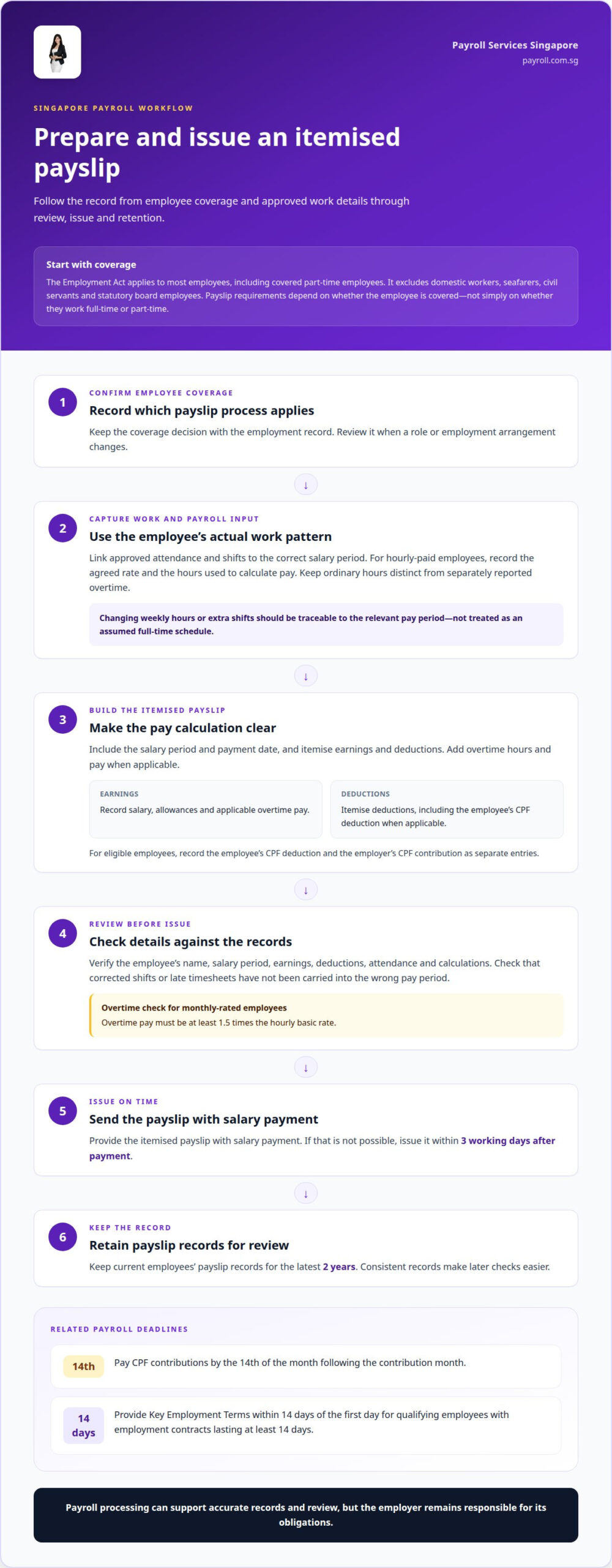
In Singapore, employers must provide itemised payslips to employees covered by the Employment Act, including covered part-time staff. Payslips must be issued with salary payment or, if that is not possible, within three working days after payment, according to the Ministry of Manpower Singapore. Accurate payslip preparation in Singapore means recording the salary period and payment date, itemising earnings and deductions, and including applicable details such as overtime hours and pay. This helps employees understand how their net salary was calculated and supports reliable payroll records. This guide explains what a payslip must include, when to issue it and how the itemised requirements apply to part-time staff, so you can manage payroll administration accurately as your business grows.
Key Takeaways
- Learn which pay, deduction and salary-period details make an itemised payslip clear and complete.
- Understand how payslip requirements apply to part-time employees and what payroll records need consistent handling.
- Plan payroll inputs and review responsibilities to reduce errors when preparing payslips across different employee arrangements.
- Keep CPF deadlines in view: according to the Central Provident Fund Board, employers must pay CPF contributions by the 14th of the month following the contribution month.
Why Use a Professional Service to Prepare Itemized Payslips in Singapore?
Professional payroll processing keeps salary calculations, payslip details and payroll records aligned across each cycle. A payroll specialist can process payroll inputs, calculate salaries, generate payslips and review calculations before payment. This is especially useful when employees have different arrangements, overtime or allowances.
Part-time and temporary employees are covered when the Employment Act applies to their employment. The Act applies to most employees, including covered part-time employees, but excludes domestic workers, seafarers, civil servants and statutory board employees. CPF coverage is a separate question: foreign employees on Singapore work passes are not covered by CPF.
CPF calculations depend on eligibility, age and wages. From 1 January 2026, Singapore Citizens and permanent residents aged 55 and below who earn over S$750 a month contribute 20% of their wages to CPF, according to the Central Provident Fund Board. From 1 January 2026, employers contribute 17% of wages for employees aged 55 and below who earn over S$750 a month, according to the Central Provident Fund Board. Employers must pay CPF contributions by the 14th of the month following the contribution month, according to the Central Provident Fund Board.
For monthly-rated employees, overtime pay must be at least 1.5 times the hourly basic rate, according to the Ministry of Manpower Singapore. Payslips must be given with salary payment or, if that is not possible, within three working days after payment, according to the Ministry of Manpower Singapore. Key Employment Terms must reach qualifying employees within 14 days of their first day. This applies to qualifying employment contracts lasting at least 14 days.
A typo in an employee’s name, salary period or deduction can make a payslip misleading. Missed issuance deadlines can create compliance issues, while missing employment records make later review harder. Continued or serious payslip compliance violations can result in a fine of up to S$5,000. Repeated payslip violations can incur a penalty of up to S$400 per breach. Employers must keep current employees’ payslip records for the latest two years, according to the Ministry of Manpower Singapore.
A payroll specialist processes employee details, salary, allowances, deductions and applicable overtime to generate itemised payslips. Clear payroll inputs and a consistent review process help reduce errors, while the employer retains responsibility for its obligations.
Payslips for part-time employees
Part-time payroll should reflect each employee’s actual work pattern, not an assumed full-time schedule. For employees covered by the Employment Act, itemised records should make variable hours and earnings traceable to the relevant pay period.
Employer Duties for Itemised Payslips
For a part-time employee covered by the Employment Act, employers must provide an itemised account of pay. The practical challenge is recording changing shifts accurately: an employee may work different hours from week to week or take extra shifts that affect earnings. Link approved attendance information to the relevant salary period so the payslip reflects the work recorded.
Employment Act Payslip Requirements
Employment Act payslip requirements depend on whether an employee is covered, not simply on whether they work full-time or part-time. For an hourly-paid worker, payroll records should show the agreed rate and the hours used to calculate pay. Clear attendance records help explain changes in gross pay between periods, without treating a shorter schedule as an error.
When an employee’s regular hours vary from week to week, distinguish ordinary recorded hours from separately reported overtime in the payroll process. This makes pay easier to understand and gives the employer a clearer basis for reviewing a question about a particular shift or pay period.
Employee and Employer CPF Contributions
For eligible part-time employees, payroll must account for CPF contributions under the applicable rules and based on the wages recorded for the period. Variable hours can change the wage figure used in the calculation, so approved shifts and pay components need to flow accurately into payroll. The employee’s CPF deduction and the employer’s contribution are separate entries, with different effects on take-home pay and employer records.
Consistent handling of changing schedules can help prevent a late timesheet or corrected shift record from being carried into the wrong pay period. If your team needs help coordinating these payroll inputs, payroll administration support can assist with recurring processing.
Are payslips legally required in Singapore?
Yes. Singapore employers must issue itemised payslips to employees covered by the Employment Act. The key question is whether the employee falls within the Act’s coverage.
Singapore Payslip Legal Requirements
The Employment Act applies to most employees in Singapore, but excludes seafarers, domestic workers, civil servants and statutory board employees. This matters when your workforce includes different employment categories: do not assume one rule applies to every worker. Establishing which employees are covered helps you apply payslip procedures consistently and identify where employment records need different handling.
If your business has employees in different roles, record each coverage decision clearly. This gives managers a consistent basis for applying the right payroll process when roles or employment arrangements change.
Required Payslip Details
Legal coverage determines whether the payslip requirement applies to an employee; it is separate from the information required on an individual payslip. Keep the coverage assessment with the employee’s employment record, particularly when roles change or a worker moves between arrangements. This helps ensure the general payroll process takes the employee’s status under the Act into account.
For example, a change in job category may mean you need to review how an employee is classified for payroll administration. Recording that review supports consistent decisions across the workforce.
Payslip Record-Keeping Requirements
According to the Ministry of Manpower Singapore, employers must keep payslip records for current employees for the latest two years. For former employees, employers must keep records for the last two years and retain them for one year after the employee leaves. These periods make a clear retention process important, especially when staff leave or payroll responsibilities change.
Organise records so an authorised reviewer can retrieve an employee’s history by name and employment period. For example, a former employee’s query should be traceable to the relevant retained file without searching unrelated records. This supports continuity when payroll administration changes hands.
Business challenges adopting itemised payslips
Itemised payslips can reveal inconsistencies between payroll records and the way a business describes pay components. Different teams may use different labels for the same allowance or deduction, making reports harder to interpret. For payslip preparation in Singapore, agree on consistent descriptions and assign each component to the right category so employees and reviewers can understand the records.
Payroll system configuration also needs attention. Existing pay codes, employee records and report layouts may need to be aligned with itemised payslip requirements. If one code groups several payment types together, the payslip may not explain each component clearly. Review the mapping before adopting a new format to identify gaps without changing the underlying employment terms.
Responsibilities can become unclear when payroll tasks are shared across finance, operations and management. One person may update employee details while another approves payroll, yet no one may own the final review of the payslip. Define who maintains records, approves changes and authorises release. Clear ownership supports consistent payslip preparation in Singapore, even when internal responsibilities shift.
Protecting payroll data is another operational consideration. Itemised records contain personal salary information, so access should match each person’s role. Keep controlled copies in an agreed record system rather than circulating multiple versions through informal channels. A clear version history also helps reviewers distinguish approved changes from drafts or corrections.
The practical takeaway is to treat implementation as a process-design task, not merely a form change. Align pay-component labels, system settings, approval ownership and record access before relying on the new workflow. If your team needs help coordinating recurring payroll administration, get support with payroll administration as you establish a consistent process.
Payroll Services Singapore
Payroll Services Singapore supports employers with consistent payroll processing and administration, including employee payslip preparation. Its outsourced payroll services can help when recurring tasks, changing employee pay inputs or review deadlines are becoming difficult to manage in-house. Employers remain responsible for their payroll obligations, while clear coordination supports accurate records and timely processing.
The team also handles statutory year-end IR8A form submissions for annual employee income reporting. This can be a relevant extension of payroll administration when your business needs both regular payroll processing and year-end reporting handled in a coordinated way.
Contact Payroll Services Singapore to discuss payroll administration support for your business.
Set a dependable payroll process for what comes next
As your business grows, payroll arrangements may change alongside roles, work patterns and reporting needs. Treat payslip preparation in Singapore as part of a wider operating process: define who provides payroll inputs, who reviews exceptions and how approved changes are recorded. Clear ownership helps your team maintain continuity as responsibilities shift or payroll becomes more complex.
Outsourced support can manage recurring payroll administration, but it does not remove your responsibility as the employer. Your team still needs to provide accurate information and oversee payroll decisions. Payroll Services Singapore brings expertise in Singapore payroll regulations to its payroll work, helping keep administration aligned with your business processes.
If you are planning a change to your payroll arrangements, start a conversation about the support that fits your operation. Contact Payroll Services Singapore to discuss your requirements and take a considered next step.
Frequently Asked Questions
What is a payslip?
A payslip is an employment record showing how an employee’s salary for a pay period was calculated and paid. It separates gross earnings, deductions and the net amount received. If a worker asks why take-home pay differs from basic salary, for example, the itemised entries provide a record to review alongside payroll inputs such as hours, allowances or overtime.
How is the employee’s CPF worked out?
An employee’s CPF contribution is calculated from eligible wages using the applicable rate, which depends on factors including citizenship or permanent-resident status, age and earnings. For example, from 1 January 2026, Singapore Citizens and permanent residents aged 55 and below who earn over S$750 a month contribute 20% of their wages, according to the Central Provident Fund Board. The employer contribution is calculated separately.
How is the overtime rate calculated?
For a monthly-rated employee, the hourly basic rate for overtime calculations is 12 × basic salary ÷ (52 × 44). Overtime pay must be at least 1.5 times that hourly basic rate, according to the Ministry of Manpower Singapore. For instance, payroll processing first establishes the hourly basic rate, then applies the overtime rate to the employee’s eligible overtime hours.
Who is entitled to receive a payslip in Singapore?
Employees covered by Singapore’s Employment Act must receive itemised payslips, including covered part-time employees. The Act applies to most employees but excludes seafarers, domestic workers, civil servants and statutory board employees. If your business has different employment arrangements, establish coverage for each employee group rather than assuming part-time status removes the payslip requirement.
What must an itemised payslip include in Singapore under MOM rules?
An itemised payslip should identify the employer and employee, payment date, salary-period dates, basic salary, allowances, additional payments, deductions and net salary. It must also show overtime hours and pay when applicable. For hourly, daily or piece-rated work, include the basic rate and total hours, days or pieces worked. These details let you trace the net amount to its components.
When must employers issue payslips to employees in Singapore?
Employers must issue payslips with salary payment or, if that is not possible, within three working days after payment, according to the Ministry of Manpower Singapore. If salary is paid more than once in a month, employers may consolidate payslips, provided the consolidated record details payments since the previous payslip. Upon termination or dismissal, provide the payslip together with any outstanding salary.