The lowest payroll quote isn’t always the lowest-cost option. Payroll outsourcing costs in Singapore are commonly charged per employee each month, sometimes with a minimum monthly fee; headcount and service scope shape the total. Compare more than the quoted rate: account for the administration and compliance work your team would otherwise handle.
When weighing payroll expenses, you need a clear basis for comparing options. The right model depends on your team size, payroll complexity and how much internal oversight you want to retain. A headline fee alone won’t show the full operational picture.
This article explains how fees typically relate to headcount, what affects outsourced payroll scope, and how outsourced, in-house and hybrid models compare. Use this framework to assess the trade-offs and identify the approach that best fits your organisation.
Key Takeaways
- Compare the full operating cost, including software, staff time, onboarding and the effort required to manage errors, rather than focusing on a single fee.
- Choose between outsourced, in-house and hybrid payroll based on your headcount, internal capacity and the level of oversight you need to retain.
- Understand how payroll handover works and which recurring administration and annual reporting responsibilities need to be covered.
- Use employee numbers as a starting point for comparing monthly fee structures, then consider how payroll complexity and service scope affect the fit.
How much does payroll outsourcing cost in Singapore?
In Singapore, compare the full operating cost, not just the payroll fee. Software, staff time, setup work and the consequences of errors all affect the calculation.
Software and Staff-Time Costs
With outsourced payroll, the provider’s software and processing staff are part of the service arrangement. Your business still supplies accurate employee and monthly pay information, while the provider processes payroll and handles agreed filing tasks. With self-operated software, your team remains responsible for each pay run.
Those figures cover core work, not every internal cost.
Factors Affecting Outsourcing Costs
Headcount is one pricing factor, but payroll complexity also shapes the workload. Employee record changes, variable monthly pay, different worker categories and recurring filing can require additional processing. Skills development levy calculations and itemised payslips, for example, depend on correct employee and pay data.
Onboarding also takes work: employee details, pay arrangements and payroll procedures must be transferred and organised before routine processing begins. Error-related costs can include correcting records, recalculating pay and resolving filing issues. A clear division of responsibilities defines the service scope and helps prevent avoidable rework.
Outsourcing Versus In-House Costs
With in-house payroll, the business is responsible for software, staff time, training, compliance monitoring and backup coverage.
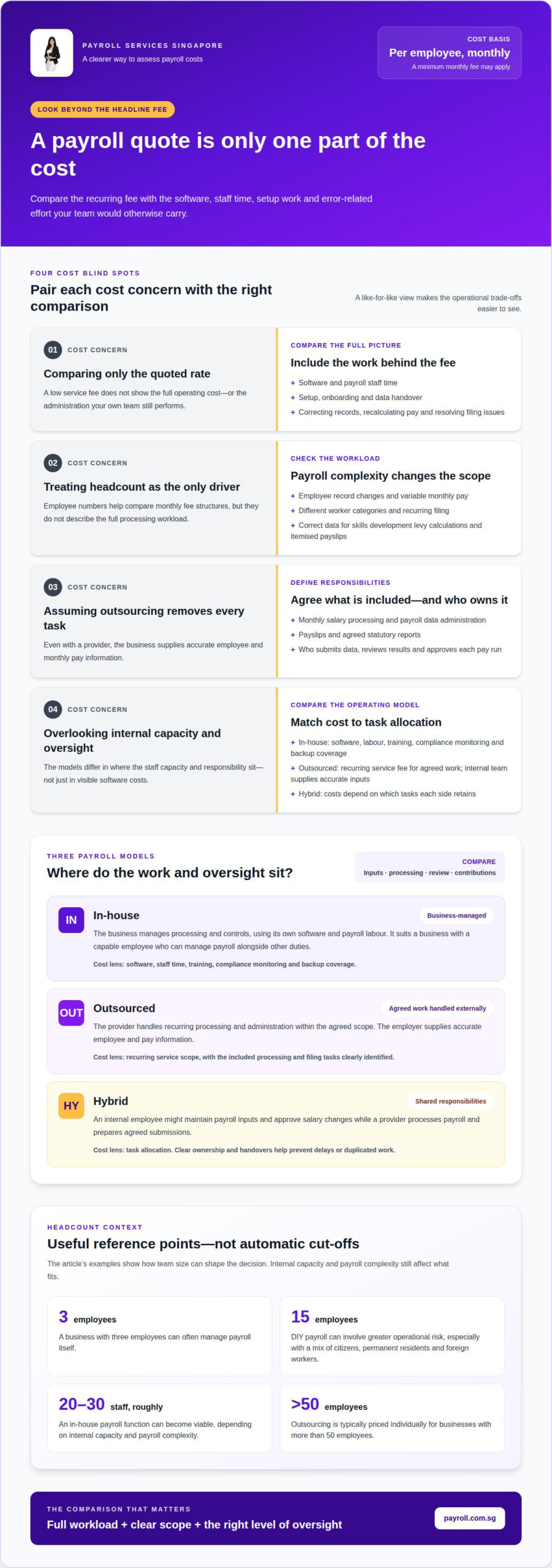
Outsourcing replaces some internal workload with a recurring service fee, while hybrid arrangements keep selected tasks in-house. The models differ in where staff capacity and oversight sit, not just in their visible software costs.
| Option | Software and staff | Internal responsibility | Cost consideration |
|---|---|---|---|
| Outsourced | Provider software and processing staff | Supply accurate payroll inputs | Recurring service scope |
| In-house | Business software and payroll labour | Manage processing and controls | Software, labour and ongoing support |
| Hybrid | Shared across provider and business | Retain selected payroll tasks | Depends on task allocation |
Choose by comparing the full recurring workload and the controls each model leaves with your team.
Outsourcing, in-house and hybrid payroll models
The right model depends on headcount, internal capacity and how much control your company wants to retain. In Singapore, a business with three employees can often manage payroll itself, while outsourcing becomes more relevant as the team grows.
In-house payroll suits a business with a capable employee who can manage salary calculations, payroll records and statutory submissions alongside other duties. As headcount increases, the work expands: a payroll administrator must maintain employee information, process monthly changes and coordinate contributions. For businesses with roughly 20 to 30 staff, an in-house function can become viable, depending on internal capacity and payroll complexity.
Outsourcing transfers agreed processing and administration tasks to a payroll provider. The provider handles recurring work within the agreed scope, while the employer supplies accurate employee and pay information. This model can reduce the time your team spends on routine payroll, particularly when it includes citizens, permanent residents and foreign workers. At fifteen employees, DIY payroll can involve greater operational risk, especially with that mix.
Hybrid payroll divides responsibilities instead of transferring the entire process. For example, an internal finance employee could maintain payroll inputs and approve salary changes, while a provider processes payroll and prepares agreed submissions. This approach preserves internal oversight but requires clear ownership, consistent handovers and a defined approval process. Without those controls, shared responsibility can lead to delays or duplicated work.
Compare the models by identifying who prepares employee data, processes monthly pay, reviews results and manages statutory contributions. In-house payroll concentrates those tasks internally; outsourcing assigns agreed duties externally; hybrid arrangements split them. Above roughly 20 to 30 staff, an internal function may become viable, while businesses with more than 50 employees are typically priced individually for outsourcing. Choose the structure that matches available expertise and oversight needs. For a practical view of outsourced administration, explore payroll administration options.
What does payroll outsourcing cover, and how does the handover work?
Outsourced payroll can cover monthly salary processing, payroll data administration, payslips and agreed statutory reports. During handover, the provider organises employee records, pay components and processing arrangements, then uses that information to run payroll. Clear roles for submitting data, reviewing results and approving the pay run help keep each cycle orderly.
Published fee structures commonly use a per-employee monthly rate and may include a minimum monthly charge. The price depends on the case and is given after a quote request; employee numbers, payroll scope, reporting requirements and data complexity affect the cost. A quoted fee is most useful when it clearly identifies the included processing and filing tasks.
Handover begins with payroll data, including employee details and salary components. The provider can then establish how changes are submitted, who reviews payroll results and how approvals are recorded. This defined sequence reduces manual follow-up and gives the employer a clear point to review the completed pay run.
Annual income reporting also needs a defined owner and timetable. According to the Inland Revenue Authority of Singapore, employers with 5 or more employees must submit employees’ income information electronically under AIS by 1 March each year. Providers may prepare reports, but employers should retain oversight of the information submitted.
Employers remain responsible for payroll compliance, even when a provider processes payroll data. For example, written Key Employment Terms must be issued within 14 days after an employee’s first day. Employers must also provide itemised payslips with payment or within 3 working days, and retain the required records.
Departing foreign employees can require additional coordination. IRAS generally requires tax clearance when a foreign employee or Singapore permanent resident stops working for an employer or leaves Singapore. Where required, an employer should generally file Form IR21 at least one month before a non-Singapore Citizen employee leaves employment or meets another specified departure condition. Share departure details promptly so payroll and reporting responsibilities can be coordinated.
Monthly payroll outsourcing fees by headcount
Monthly fees often scale with employee numbers because each additional worker adds payroll data to process, review and maintain. Singapore pricing may also reflect the agreed scope, payroll complexity and reporting requirements. A headcount band helps frame comparisons, but won’t show whether accounting support, manual adjustments or extra filings are included.
For a useful comparison, group your current team into a broad size band, then match the quote against its deliverables. A 1-5 employee team has a different annual processing volume from a 31-50 employee team. Within either band, variable salary components, employee changes and the number of review steps can affect the workload. A minimum charge can also shape the effective cost for a smaller team.
| Headcount band | What to compare in the monthly scope |
|---|---|
| 1-5 employees annually | Minimum charge, standard pay run and itemised payslips |
| 6-15 employees | Employee changes, review steps and payroll data handling |
| 16-30 employees | Reporting scope, manual adjustments and approval workflow |
| 31-50 employees | Processing responsibilities, accounting coordination and reporting needs |
These bands support a like-for-like comparison, not a published fee schedule. Payroll software used by an internal team is a separate cost from an outsourced service, so don’t compare software alone with a provider’s full processing scope. Establish which party handles corrections, filing and follow-up when information needs amendment. Clear responsibilities make comparisons more direct and help reduce duplicated work.
The price depends on the case and is given after a quote request; headcount, payroll complexity, reporting requirements and the agreed service scope affect the cost. A complete assessment considers operational effort as well as the risk of errors. For example, incorrect itemised payslips may need correction and could expose an employer to penalties, while skills development levy calculations add another recurring detail to manage.
For a quote based on your headcount and payroll requirements, request a payroll outsourcing quote.
Payroll Services Singapore
Payroll Services Singapore helps businesses assess payroll outsourcing as an operational choice, then manage recurring payroll work and administration. Its end-to-end payroll processing supports timely salary disbursements, while IR8A reporting helps employers prepare annual employee income submissions.
Consider payroll support when internal tasks take time away from finance operations or your organisation wants a defined process for routine payroll administration. The appropriate scope depends on your headcount, payroll requirements and the responsibilities you want handled. Reviewing these needs gives you a practical basis for discussing the service arrangement, rather than treating a general market estimate as a quotation.
For a discussion about your payroll requirements, contact Payroll Services Singapore.
Make payroll a deliberate operating decision
Treat payroll outsourcing cost in Singapore as an operating decision, not an isolated line item. The right arrangement should fit how your organisation manages approvals, employee changes and payroll oversight. Use the comparison to set a workable balance between external processing and internal control as your business evolves.
Before deciding, turn your priorities into a concise scope: identify which payroll responsibilities you want handled, what information your team will provide and where approvals should sit. This gives you a clearer basis for discussing service scope and responsibilities than relying on a headline estimate that may not reflect your operating needs. It also connects cost decisions to accountability, continuity and the capacity your internal team can sustain.
A focused discussion can help translate those requirements into a practical next step. Discuss your payroll requirements with Payroll Services Singapore and move forward with a structure that supports your organisation’s priorities.
Frequently Asked Questions
Is it cheaper to outsource payroll or do it in-house?
Outsourcing costs less when its service fee is below the combined internal cost of payroll labour, software, training, backup and corrections. In-house payroll costs less when capable staff already have the capacity and systems to manage it without added support. For example, a company with limited finance capacity should count the time payroll takes away from accounting work, not just its software bill.
Does outsourced payroll include IR8A and the Auto-Inclusion Scheme?
It can include IR8A reporting, but the exact scope depends on the services agreed. Payroll Services Singapore prepares and processes IR8A forms and required appendices for employee remuneration reporting. Employers remain accountable for their submissions, so define who prepares the reports, supplies employee information and approves the final data. This distinction helps prevent an assumption that monthly payroll processing automatically covers annual reporting.
How is employee data protected when you outsource payroll?
Data protection depends on clear access controls and disciplined handling of payroll records. Share only the information needed for processing, identify which staff can approve changes, and use a controlled method to transfer payroll files. Set expectations for correcting inaccurate records and managing access when responsibilities change. These practices help limit unnecessary exposure of salary and employee details during routine payroll administration.