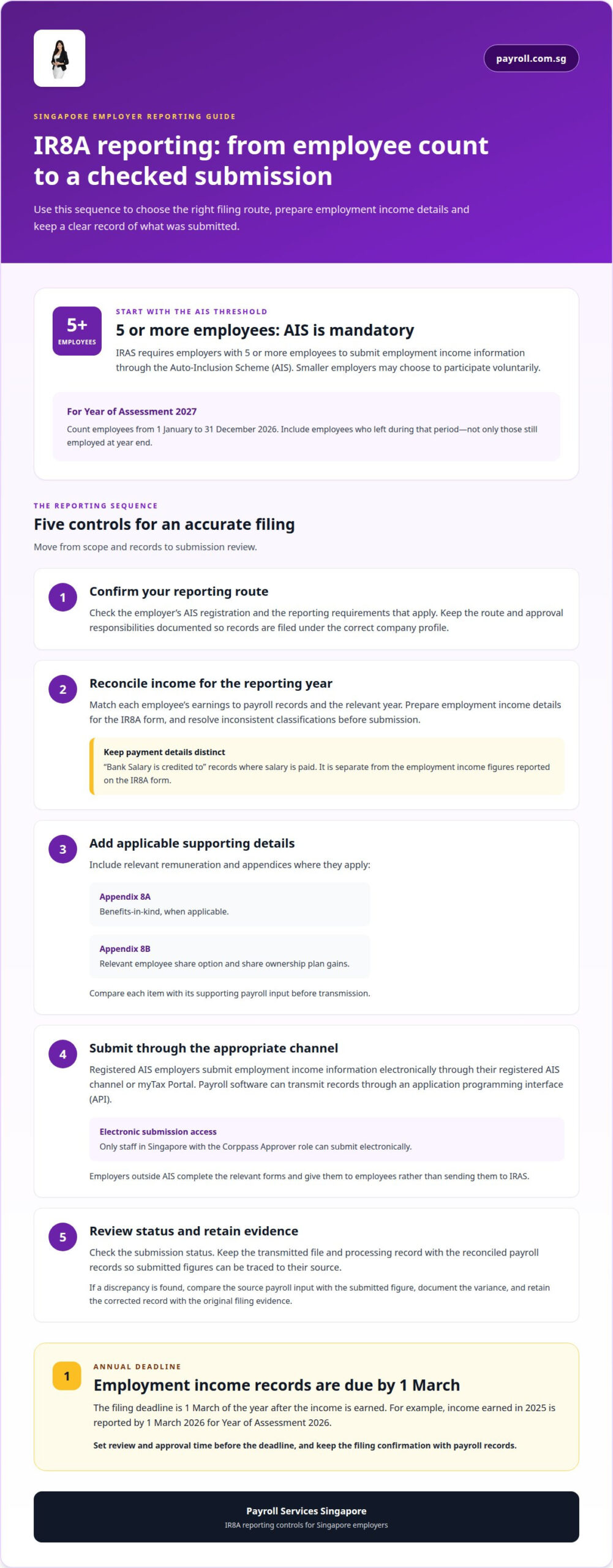
Complete the “Bank Salary is credited to” field when the employee’s salary is paid into a bank account; the field records payment details, while the IR8A reports employment income. To prepare employee IR8A submissions accurately, you also need to identify the applicable appendices and follow the correct filing route. According to the Inland Revenue Authority of Singapore (IRAS), the Auto-Inclusion Scheme is mandatory for employers with 5 or more employees.
Annual reporting has a fixed deadline: employment income records are due by 1 March of the year after the income is earned. That makes accurate payroll input, a clear review process and timely submission practical priorities, particularly for growing businesses managing year-end administration without a dedicated HR team.
This guide explains how to handle the bank salary field, which information and appendices may be needed, and how electronic submission works. You’ll also learn what preparation and filing duties apply, so you can manage the process clearly and keep payroll records aligned with reporting responsibilities.
Key Takeaways
- Separate salary payment details from the employment income figures reported on the IR8A form.
- Understand how payroll software can support electronic income reporting and what submission steps require attention.
- Identify whether your business must join the Auto-Inclusion Scheme or can choose to participate.
- See which employee income and supporting appendices may need to be included in year-end reporting.
Must the employer complete the ‘Bank Salary is credited to’ field in the IR8A form?
- Complete the bank salary field when it applies to the employee’s salary payment. It records where salary is credited; it is distinct from employment earnings reported on the IR8A form. Use the bank details relevant to the salary payment, rather than substituting take-home pay for gross income. Singapore employers report earnings for the calendar year from 1 January to 31 December.
- Set the employee-copy deadline alongside the annual reporting deadline. Employers outside the Auto-Inclusion Scheme (AIS) must give each employee an IR8A form by 1 March. Employers prepare forms for income earned in the previous calendar year, including applicable appendices. For example, income earned in 2025 is reported by 1 March 2026 for Year of Assessment 2026. Keep a record of when each employee receives their form.
- Plan AIS registration and electronic submission separately. An employer not registered for AIS can register by 31 December for the next year’s assessment. Plan electronic submissions well ahead of the annual deadline. For Year of Assessment 2027, employers can register until 1 March 2027. Prepare payroll records in advance to allow time for submission. These dates help you schedule review and approval responsibilities.
- Act before the deadline, because late filing can carry penalties. Under section 94 of Singapore’s Income Tax Act, late or non-submission of IR8A or AIS records can result in a fine of up to S$5,000. Employers who miss the AIS deadline may face a fine of up to S$1,000 upon conviction. Keep the filing confirmation with payroll records. A separate clearance duty may apply when a foreign employee or Singapore Permanent Resident leaves: Form IR21 is due at least one month before departure, or before leaving Singapore for more than three months.
How can you submit employment income records to IRAS electronically?
You can confirm the employer’s reporting route, compile income details, then submit and review the records. A controlled workflow also helps you identify and resolve discrepancies.
-
How you can check employer reporting requirements
Confirm whether you must submit employee income information electronically. Under section 68(2) of Singapore’s Income Tax Act, employers specified in the relevant gazette must submit it electronically to IRAS. Check your AIS registration and authorised Corppass access before preparing a file. Keep the reporting route and approval responsibilities documented, so you do not submit under the wrong company profile.
-
How you can compile employment income information
Reconcile each employee’s earnings against payroll records and the relevant reporting year. Prepare the IR8A form with employment income, then include applicable details for benefits-in-kind and other remuneration. Appendix 8A reports benefits-in-kind when applicable; Appendix 8B covers relevant employee share option and share ownership plan gains. Compare each item with its supporting payroll input, and resolve inconsistent classifications before transmission.
-
How you can submit records through payroll software
Prepare the approved payroll file and transmit employment income records through payroll software using an application programming interface (API). Before transmission, compare employee identifiers, income categories and supporting data against reconciled payroll records. Retain the transmitted file and its processing record together so you can trace submitted figures to their source. A controlled file hand-off also reduces the risk of using an outdated export.
-
How you can file employee income information electronically
Submit through your registered AIS channel or myTax Portal, then review the submission status. Only staff in Singapore with the Corppass Approver role can submit electronically. If a later review identifies a discrepancy, isolate the affected employee record, compare the source payroll input with the submitted figure, and document the variance. Submit the correction through the appropriate electronic process and retain the updated record with the original filing evidence. IR8A reporting support can help coordinate these controls.
Electronic filing thresholds and notices
- Count employees for the relevant assessment year and confirm your filing route. AIS is mandatory in Singapore for employers with 5 or more employees, according to the Inland Revenue Authority of Singapore (IRAS). For Year of Assessment 2027, count employees from 1 January to 31 December 2026, including staff who left during that period. Employers with 5 or fewer employees may participate voluntarily.
- Keep the employee-count calculation with your year-end payroll records. Include employees who worked during the count period, even if they left before the year ended. This prevents the count from reflecting only staff still employed on the final day. Record the period reviewed and the employee list used so the basis for your AIS decision is clear during internal review.
- Match the submission route to the employer’s AIS status. Registered AIS employers submit employment income information electronically. Employers outside AIS complete the relevant forms and give them to employees rather than sending them to IRAS. Smaller employers may choose to join the scheme voluntarily. Keep the registration decision with payroll administration records so staff handling year-end reporting can follow the same route.
- Continue electronic reporting if the employer has already joined AIS. Registration does not end simply because the employee count later falls below 5; registered employers must continue electronic submissions. Add this continuing obligation to the payroll calendar and handover notes, especially if staffing changes between assessment years. When responsibilities move between finance and payroll, document who maintains the AIS process and who approves the employee income file.
Employers’ IR8A preparation and submission obligations
- Assign compensation to the year the employee becomes entitled to it. For bonuses, use the year entitlement arises rather than relying only on the payment date. Apply the same approach to director’s fees: report them in the year the director becomes entitled to the fees. For example, if payment follows entitlement in a later period, establish which year the entitlement belongs to before finalising the return.
- Review unusual remuneration events separately from routine salary entries. A bonus approval, director’s fee decision or revised remuneration arrangement can affect the year in which income is assessed. Keep the relevant decision and date with the payroll working papers, then compare the assessment year used with the employee’s income record. This gives reviewers a clear basis for resolving timing differences.
- For a crew member who worked aboard a shipping vessel during 2025, include the applicable ship-registration and operating-area code in the Singapore IR8A reporting. Confirm the employee’s vessel assignment and operating area against the employer’s supporting records before the information is finalised. These codes provide context for the reported employment, rather than replacing the income figures or the supporting payroll documentation.
- Build a review trail for each unusual item before approving the final return. Record how the team treated entitlement dates, director’s fees and any applicable vessel codes, and retain supporting material with the employee’s payroll records. If a reviewer questions a figure, the record should show the decision made and its basis. A consistent review process keeps reporting decisions traceable across payroll, finance and management.
Payroll Services Singapore: IR8A reporting
Payroll Services Singapore prepares and processes IR8A forms and required appendices for employee remuneration reporting. Its IR8A reporting supports employers with statutory year-end employee income submissions, bringing payroll records and filing preparation into a coordinated process.
Consider this support if year-end reporting is adding pressure to your payroll team or you need help organising employee income details and relevant appendices. Payroll Services Singapore also provides recurring payroll administration through outsourced payroll services. You remain responsible for the accuracy of the information provided and your employer obligations, while the reporting work is handled with attention to Singapore payroll regulations.
To discuss IR8A reporting support, contact Payroll Services Singapore.
Set up a clear process for the next reporting cycle
The next reporting cycle is easier to govern when ownership is clear before year-end. As you prepare employee IR8A submissions, define who supplies payroll input, who reviews exceptions and who approves the final information. A responsibility map can reduce hand-off gaps between finance, payroll and management without shifting the employer’s statutory accountability.
Build the process around consistent records, not a last-minute file. Keep changes to remuneration, employee status and supporting documents connected to the relevant payroll period so reviewers can trace each figure to its source. Payroll Services Singapore’s team is knowledgeable about Singapore payroll regulations, helping businesses manage reporting work while keeping internal review responsibilities clear.
If you’d like professional support with your reporting process, contact Payroll Services Singapore. A clear division of work can help your team approach the next cycle with confidence.
Frequently Asked Questions
What is IR8A?
An IR8A form is an employer’s annual statement of an employee’s income for Singapore tax reporting. It helps ensure the income information used in the employee’s personal tax assessment reflects relevant employment earnings. For example, an employee can use the form to review reported remuneration against their own records. It is an income reporting document, not a payslip or a notice of tax payable.
Are there other forms besides IR8A which I should take note of?
Yes. The relevant additional form depends on the remuneration or contributions involved. Appendix 8A covers benefits-in-kind, while Appendix 8B is used for applicable employee share option and share ownership plan gains. Form IR8S applies where excess CPF contributions were made and a refund has been claimed or will be claimed; it applies only before Year of Assessment 2026. Each form addresses a specific reporting situation.
How can you amend IR8A records after submission?
A payroll specialist submits an amendment through AIS after identifying an error, reporting the difference between the amount previously filed and the actual amount. The correction should be completed before the relevant filing process closes, with the revised figures supported by payroll records. For AIS amendments made between 1 March and 18 April, updated figures generally appear in employees’ myTax Portal within 5 working days.
Is it compulsory to submit IR8A form?
The Inland Revenue Authority of Singapore (IRAS) requires employers with 5 or more employees to use AIS. Employers outside AIS prepare the forms and give them to employees; they do not submit those forms to IRAS. AIS employers send employee income information electronically. This distinction matters when assigning filing responsibilities: confirm the company’s reporting route, then ensure employees receive the required income information in the appropriate format.
What is IR8A form and who must file it in Singapore?
IR8A form is the annual employee income statement used for Singapore tax reporting. The employer prepares it for individuals who worked for the company during the calendar year, subject to applicable exceptions. An employee does not file the employer’s IR8A submission. For example, an employee who left during the year may still have reportable income, so departure alone does not settle whether reporting is needed.
What is the IR8A submission deadline for the current tax year?
For Year of Assessment 2027, employers must report income earned in 2026 by 1 March 2027. The deadline applies to the income year before the assessment year, so identify the relevant year before scheduling filing work. For a different assessment year, use the deadline associated with that year’s income reporting rather than carrying forward a prior year’s submission date.