The IR8A form is Singapore’s annual employee income form, and reporting is not limited to employees still on your payroll: employers generally need to include people who received employment income during the income year, including employees who resigned.
The IR8A submission requirements for employers also determine the filing route: according to the Inland Revenue Authority of Singapore, employers with 5 or more employees as at 1 January 2026 must submit employee income information electronically through the Auto-Inclusion Scheme (AIS), while employee details still need to be prepared accurately.
This article explains which employees and remuneration to include, how AIS determines whether information is sent to IRAS or provided to employees, which appendices may apply, and when filing is due. These distinctions are especially useful if your workforce includes former employees, directors, part-time staff or people receiving benefits. They help you plan payroll close, assign review responsibilities and prepare year-end reporting.
Key Takeaways
- Set your filing schedule around the IR8A deadline: submissions are due by 1 March of the year after the income year.
- Include employees who received income during the year, including eligible former employees, part-time staff and directors.
- According to the Inland Revenue Authority of Singapore, employers with 5 or more employees as at 1 January 2026 must submit employee income information electronically through AIS.
- Determine whether your filing route is AIS or providing completed forms to employees, then align payroll records and review responsibilities with that process.
IR8A deadline: When must you file?
Set the filing date against the income year, not the date you prepare the form. Singapore employers must submit IR8A income information annually by 1 March of the year following the income year; late submission may result in a fine of up to S$5,000.
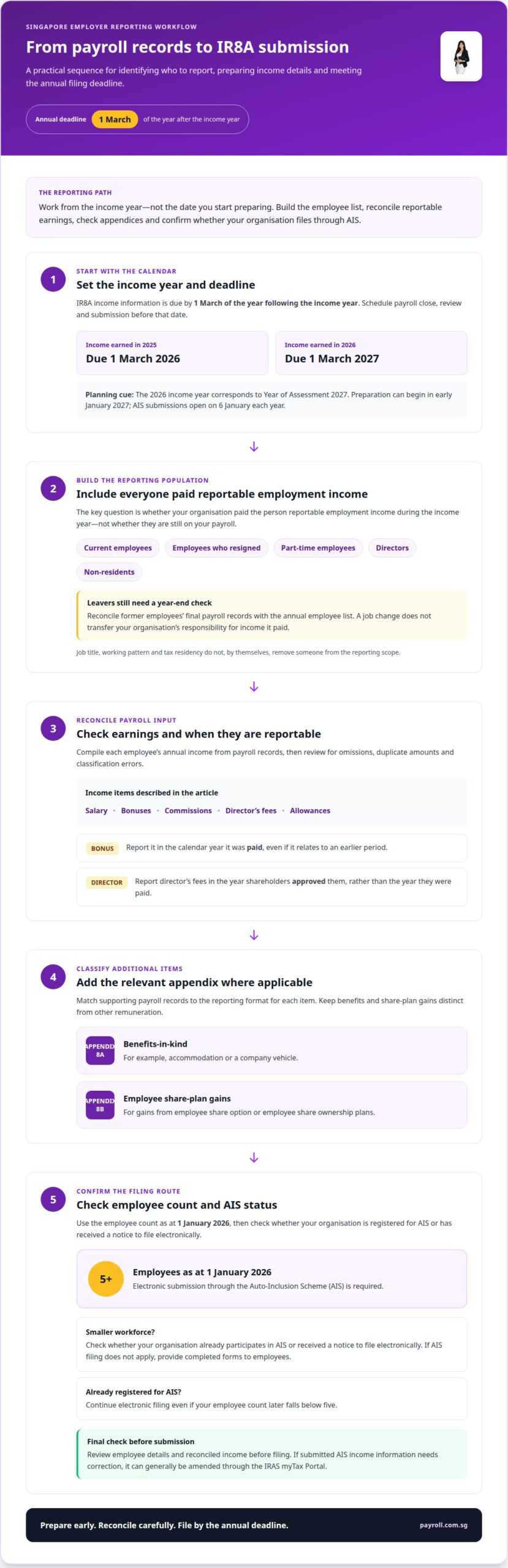
- Work back from 1 March. For income earned in 2025, the deadline was 1 March 2026; for income earned in 2026, filing is due by 1 March 2027. The 2026 income year corresponds to Year of Assessment 2027. Schedule payroll close, review and submission before the deadline, rather than treating 1 March as the date to begin preparing income information.
- Set a preparation and review sequence. Finalise payroll data, including salary, bonuses and allowances, before compiling each employee’s IR8A form. For 2026 income, preparation can begin in early January 2027, and AIS submissions open on 6 January each year. Leave time for a review and corrections before submitting through the portal.
- Account for departures and job changes. A payroll specialist includes an employee who resigned during the income year if they received reportable employment income from your organisation. A job change does not transfer your reporting responsibility for income your organisation paid. Separately, a foreign employee or Singapore Permanent Resident leaving for more than three months may require Form IR21 at least one month before departure.
- Classify additional remuneration before submission. Benefits-in-kind, such as accommodation or a company vehicle, are reported using Appendix 8A; share-plan gains use Appendix 8B. The payroll specialist uses supporting payroll records to classify employment expenses accurately and prevent them from being confused with remuneration. If submitted AIS income information needs correction, the employer can generally amend it through the IRAS myTax Portal.
Which employees should a payroll specialist prepare IR8A forms for?
- Build the reporting population from paid employment. In Singapore, IR8A reporting covers employees who received remuneration, not only permanent, full-time staff. A payroll specialist includes part-time employees, directors, non-residents and others who received employment income. The key question is whether your organisation paid reportable income during the income year. Job title, working pattern and tax residency do not, by themselves, remove someone from the reporting scope.
- Include relevant former employees. Keep employees who resigned during the year in the year-end review if they received income from your organisation. For example, a part-time employee who left mid-year may still have earnings to report. The payroll specialist reconciles their final payroll records with the annual employee list, so a leaver is not missed when payroll software focuses on current staff.
- Classify earnings by type and payment year. The IR8A format reports taxable employment income such as salary, bonuses, commissions, director’s fees and allowances. A bonus is reported in the calendar year it was paid, even if it relates to an earlier period. Director’s fees are reported in the year shareholders approved them, rather than the year paid. These distinctions help keep income tax records correct.
- Match each person to the right reporting details. The payroll specialist reconciles employee earnings against payroll records and identifies applicable appendices. For example, Appendix 8A covers benefits-in-kind, such as accommodation or a company vehicle. Foreign employee status does not automatically exclude someone from IR8A reporting; separate tax clearance requirements may also apply when a person leaves. Clear records help the payroll reviewer distinguish annual income reporting from departure-related steps.
Employers required to submit information to IRAS
For employers, IR8A submission requirements depend on employee count and AIS registration status. The steps below show how to determine your filing route and prepare the information.
-
How a payroll specialist identifies employers required to submit information to IRAS
Count your employees as at 1 January 2026, then check whether your organisation is registered for AIS. According to the Inland Revenue Authority of Singapore, employers with 5 or more employees as at 1 January 2026 must submit employee income information electronically through AIS.
If your workforce is smaller, check whether your organisation already participates in AIS or received a notice to file electronically. Employers already registered must continue electronic filing even if their employee count later falls below five. These IR8A submission requirements for employers mean headcount alone does not determine the filing route.
-
How a payroll specialist determines the information to include in Form IR8A
Prepare annual income information from payroll records for the previous calendar year. The IR8A form reports employment earnings such as salary, bonuses, commissions, director’s fees and allowances. A payroll specialist reconciles these entries against payroll records to identify omissions, duplicate amounts and other errors before submission.
Then assess whether an appendix applies. Appendix 8A reports benefits-in-kind, including accommodation or company vehicles. Appendix 8B reports gains from employee share option or employee share ownership plans. Include the relevant appendix with an employee’s income information where applicable. This classification helps keep each item within its appropriate reporting format.
- Confirm the reporting period before preparing the AIS file. For Year of Assessment 2026, employers report income earned from 1 January 2025 to 31 December 2025. Checking the period helps prevent payroll updates from entering the wrong annual submission.
- Before submission, compare employee details and income totals with final payroll records, then send the information to IRAS by the applicable deadline. Income reported through AIS is generally pre-filled in employees’ individual tax returns, so accurate figures help support their tax assessment. Assigning clear review responsibilities can help catch errors before filing.
How does a payroll specialist submit IR8A forms to IRAS?
First, confirm whether your organisation files through AIS or follows the eligible non-AIS process. The filing route determines how employee income information reaches IRAS and how completed forms are provided.
- Confirm the filing route and access. For AIS filing, the payroll specialist prepares employee income information for electronic submission to IRAS. If your organisation is joining AIS for the first time, authorise the relevant staff member or third party to submit information on its behalf through CorpPass. Confirm access before preparing the submission, so an administrative delay does not interrupt the filing sequence.
- Prepare and review the submission data. Reconcile the IR8A form and applicable appendices against final payroll records, including employee details and reported remuneration. AIS submissions open on 6 January each year, and employers are encouraged to submit by 10 February. Use this early window for review and correction, while retaining the 1 March filing deadline.
- Submit using the correct process. AIS employers send the required employee income information electronically to IRAS. Employers not under AIS generally provide completed hardcopy IR8A forms and relevant appendices to employees by 1 March. They do not need to send hardcopy forms to IRAS unless requested. Keep these routes separate; sending employee copies is not the same as electronic AIS filing.
- Address changes and retain records. AIS participants can generally amend submitted employee income information through the IRAS myTax Portal. Record what was corrected and keep payroll and IR8A-related records for at least 5 years. This creates a clear audit trail if a later review identifies a mismatch between the submitted information and payroll records.
For support with the submission process, get help with payroll administration.
Payroll Services Singapore: IR8A reporting
Payroll Services Singapore prepares and processes IR8A forms and required appendices for employee remuneration reporting. Its IR8A reporting is a practical next step when year-end submissions add pressure to your payroll team or your business lacks dedicated HR support.
You provide the relevant payroll information and remain responsible for employer review and compliance. Payroll Services Singapore supports recurring administration through outsourced payroll services, helping connect year-end reporting with payroll records and processes.
Consider this support if employee income information, applicable appendices or submission coordination require more structured handling. Contact Payroll Services Singapore to discuss your IR8A reporting needs.
Make year-end reporting part of your operating rhythm
Turn annual reporting into a defined payroll responsibility, with clear ownership of data preparation, review and submission. A repeatable process helps your team manage handovers and preserve the records needed for future review. A clear understanding of IR8A submission requirements for employers can support that discipline without making compliance a last-minute exercise.
Payroll Services Singapore’s team applies its expertise in Singapore payroll regulations through IR8A reporting, Payroll Services and outsourced payroll services. This support can help you coordinate recurring administration and year-end reporting, while your organisation retains responsibility for its review and compliance decisions.
Choose the next step that fits your team’s workload and reporting needs. Contact Payroll Services Singapore to discuss support for your payroll administration. With defined responsibilities and dependable processes, you can approach the next reporting cycle with greater operational clarity.
Frequently Asked Questions
What is the Singapore IR8A form?
The IR8A form is the annual statement employers use to report an employee’s taxable employment income in Singapore. It helps employees review the income information used for their individual tax assessment. For example, an employee can compare reported earnings with salary records and raise a discrepancy through the appropriate employer process. Employers should retain supporting payroll records so reported figures can be traced.
What are the penalties for not filing IR8A?
Failure to comply with AIS submission requirements can result in a fine of up to S$1,000 upon conviction. An AIS deadline breach can also lead to imprisonment for up to six months in default of payment. These are legal consequences, not administrative charges. Keep evidence of submission and any correction records, so your organisation can respond accurately if IRAS follows up.
What Additional Appendices Might Employers Need to Submit?
Employers may need Appendix 8A for benefits-in-kind, such as accommodation or a company vehicle, and Appendix 8B for gains from employee share option or employee share ownership plans. Match each appendix to the income item it reports. For example, share-plan gains belong with Appendix 8B, not in an unrelated benefits category. Include applicable appendices with the employee’s income reporting.
What happens if an employer files IR8A late?
Late IR8A submission may result in a fine of up to S$5,000. A missed filing can also delay the availability of accurate employment income information for an employee’s tax assessment. Submit as soon as possible and retain the submission record. If you find an error after AIS filing, employers can generally amend submitted employee income information through the IRAS myTax Portal.
Do employers need to give employees a hardcopy IR8A?
Employers not under AIS must give employees completed hardcopy IR8A forms and relevant appendices by 1 March each year. They generally do not send those hardcopies to IRAS unless requested. For example, if your organisation files outside AIS, provide the employee copy directly and keep a record of its preparation and delivery. AIS employers submit employee income information electronically instead.
Do foreign employees need to be included in IR8A?
Yes, foreign employees who received reportable employment income from your organisation should be included; foreign status alone does not remove the reporting requirement. Keep their remuneration in the annual reporting review, including income paid before departure. Separately, tax clearance may apply when a foreign employee leaves Singapore or their employment ends. Treat that departure process as distinct from year-end IR8A reporting.